Building a framework to score brand websites for Google
Brief debrief
In 2019 Google asked Media.Monks what a brand website is worth when marketplaces handle most of the selling. Marketplaces are good at turning purchase intent into sales. But a brand’s own website is the only place where it controls the whole experience, from first inspiration to long-term loyalty. My job was to find a clear, objective way to measure something as subjective as a brand experience.

Quantifying the subjective
Conversion numbers alone can’t show what a brand’s own website is worth. A good brand site shows the brand’s character throughout the visit and still makes buying easy. The task was to take emotional things like brand identity and storytelling and find a structured way to judge how well a site delivers them. Our first criteria were too subjective to compare sites fairly, so I turned them into strict, page-level behaviours that could be checked one by one.
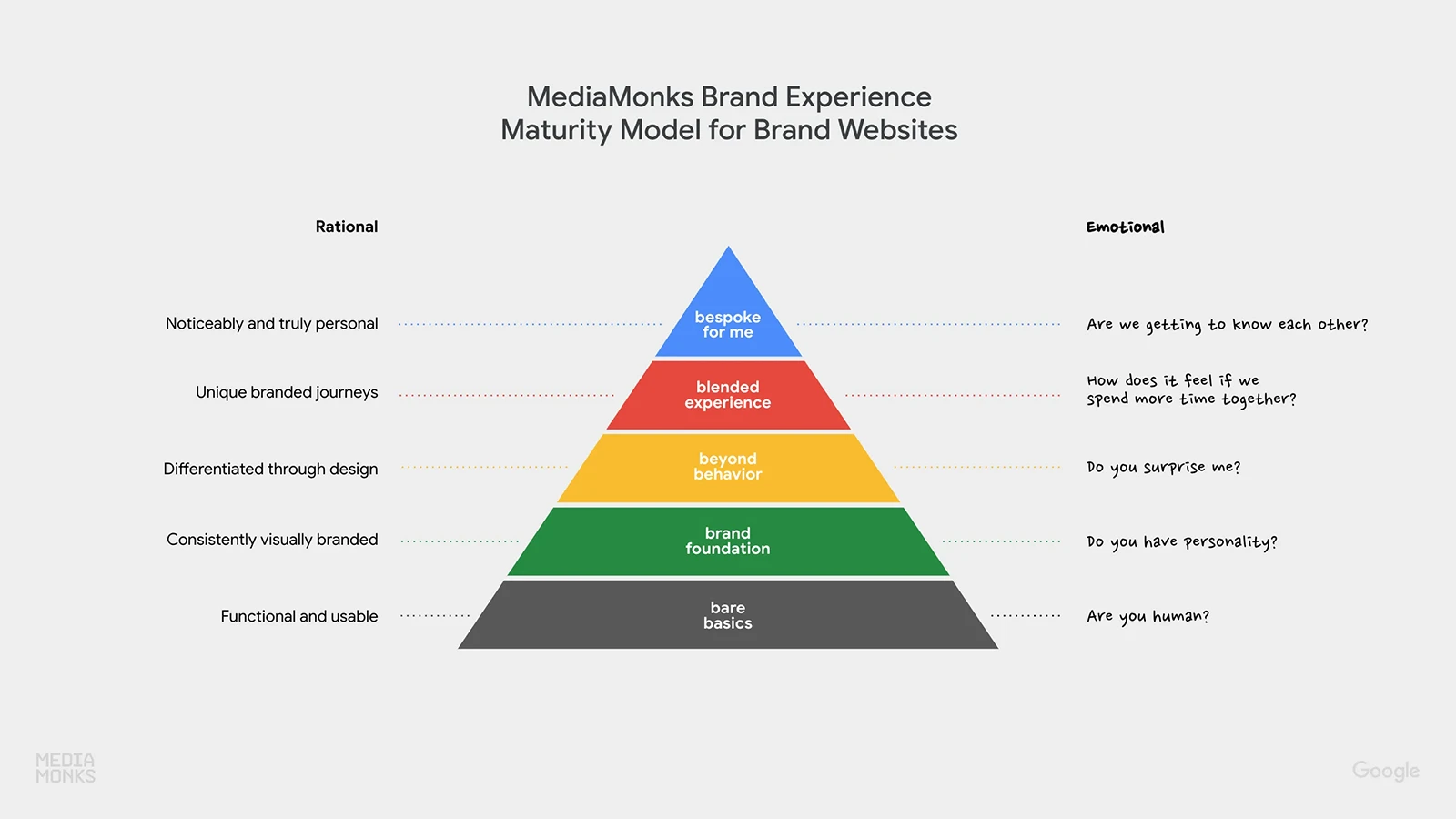
The 5x5 maturity model
The framework scores a website on five things, at five levels. The five things are Visuals, Copy, Interactivity, User Interface and Structure, each looked at through a rational UX lens and an emotional creative lens. The five levels run from “Bare Basics”, where a site just about works, to “Bespoke for Me”, where it adapts to the visitor and feels personal. For the first time, teams could see exactly where a site got its message across and where it fell short.


What the audits showed
We used the framework to benchmark the desktop and mobile sites of eight major tech manufacturers, including Apple, Dyson, HP, Samsung and Sony. Many top brands struggled with basic usability, or put all their brand effort into the moment of purchase and missed the research phase before it. The framework then became the structure for in-depth client workshops, where global brands worked out how to improve their own sites.
Amy (Lovin) Grant was a great partner in the assessment phase, and Anael Shoshan Stroh played a big part in extending the framework to FMCG sites.
Explore more
Transcript
This project for Google was really one of the more unusual projects I’ve worked on during my time at Monks. The aim was to deliver a framework with which we could measure the level of brand experience of your websites. We were trying to understand, on one hand, the creative, emotional side of what you were delivering to your customers, and on the other hand more of the usability and user experience side: how content was represented and how it was navigated.
We were able to build a heuristic assessment tool that suddenly made it possible to quantify the level of brand experience your website was able to deliver. Through this tool it also became possible to gauge whether you were doing better or worse than a competitor, or whether you had significant gaps in your brand experience.
The reason this mattered: it’s not just about creativity, and it’s also not just about usability. We were operating in a time where a lot of brands were becoming one unified soup, all focused on accessibility and clean UI design, losing every trace of their own brand expression. This tool helped us, and helped Google, have that conversation with these brands.